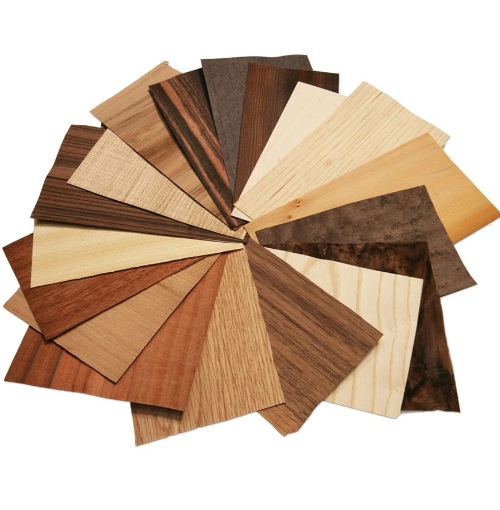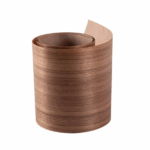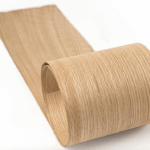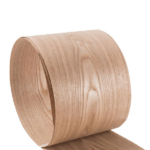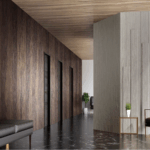
- Type: Decorative surface material made from thin slices of real wood (veneer) (0.5mm to 3mm thick), bonded to a backing material (usually Plywood, LDF, MDF, HDF, Block Boards, and Particle Boards).
- Core Material: Substrate: LDF, MDF, HDF, Plywood, Particle Board, Block Board. Surface: Real wood veneer (0.5mm – 1mm thick) or engineered veneer.
- Manufacturing: Wood logs are rotary-cut or sliced into very thin veneer sheets, which are then dried, trimmed, and sometimes stained or treated before being glued and pressed onto substrates such as LDF, MDF, HDF, Plywood, Block Boards, or Particle Boards using adhesives, and finally finished with sanding, polishing, and protective coatings.
- Construction / Adhesive Type: Veneer is cold or hot-pressed using adhesives like Urea Formaldehyde (UF), Melamine Formaldehyde (MF), or Polyurethane (PUR).
- Thickness Range: 0.3 mm, 0.5 mm, 0.6 mm, 0.8 mm, 1.0 mm, 1.5 mm (less common, for specialty uses). Most standard wood veneers for laminating furniture and panels are between 0.3 mm and 0.6 mm thick.
- Dimensions Available: 1220 × 2440 mm (Standard), 1270 × 2500 mm, 610 × 2440 mm, 915 × 2440 mm.
- Density: Depends on Substrate.
- Moisture Resistance (MR): Moderate to high (depending on substrate and adhesive; moisture-resistant or marine-grade options available).
- Fire Rating: Low to moderate (can be upgraded with fire-retardant coatings or treated substrates).
- Formaldehyde Emissions: E1 or E0 grade available (low-emission adhesives).
- Janka Hardness: Varies by wood species of veneer: e.g., Oak Veneer: ~1,290 lbf, Teak Veneer: ~1,000 lbf.
- Modulus of Elasticity (MOE): Determined by core: ~2,500 – 3,500 MPa / ~4,000 – 6,000 MPa.
- Modulus of Rupture (MOR): Determined by core: ~25 – 40 MPa / ~45 – 60 MPa.
- Dimensional Stability: High; better than solid wood, less movement due to laminated construction.
- Surface Finish: Raw, sanded, pre-polished, lacquered, UV-coated, stained, or pre-laminated.
- Color / Appearance: Natural wood aesthetics; ranges from light (Maple, Birch) to dark (Walnut, Wenge); engineered veneers offer consistent grain and color.
- Durability: Good durability because their strength depends on the core board, while the thin veneer surface requires protection from scratches and moisture; they provide a more natural and durable appearance than synthetic laminates, though they are generally less durable than solid wood.
- Mechanical Properties: Wood veneer laminates improve the appearance of a surface without adding significant strength, as their mechanical strength depends entirely on the core board such as Plywood, LDF, MDF, HDF, Block Board, or Particle Board, while the veneer itself is thin and flexible and does not provide structural support.
- Stability: Very stable due to their engineered core, which resists warping and swelling, while the veneer minimizes issues of solid wood expansion and contraction.
- Water Resistant: Standard veneer laminates are not water-resistant and must be sealed with varnish or lacquer, while moisture-resistant options are available when bonded to BWR or MR cores.
- Workability: Excellent; can be cut, routed, and finished easily.
- Screw Holding Strength: Depends on substrate: LDF, MDF, HDF, Particle Board: Moderate / Plywood, Block Board: Good.
- Edge Integrity: Edges require edge banding or lipping; raw veneer edges are delicate.
- Eco Certification: FSC, PEFC, E0/E1 formaldehyde compliance, and CARB P2 rated options available.
- Estimated Prices: Around ~US $600 – $1,000+ Per m3 / Final prices depend on raw material quality, board density and thickness, surface treatments, manufacturing technology, customization, regional costs, logistics, market demand, environmental standards, brand reputation, and order volume.
- Use Cases: Furniture finishing such as tables, wardrobes, cabinets, and shelves; interior décor applications like wall paneling, ceiling panels, and decorative surfaces; doors and partitions to achieve a premium wood look; and various architectural applications where natural wood aesthetics are desired at a lower cost.