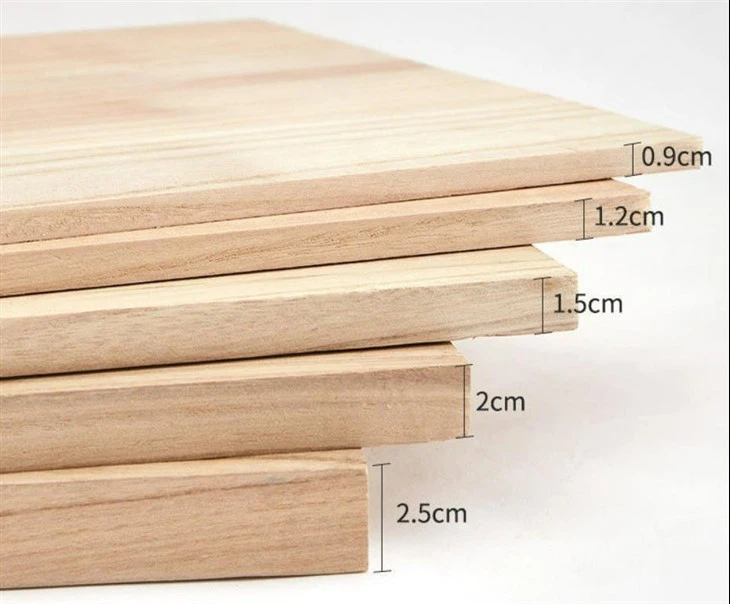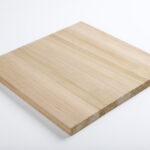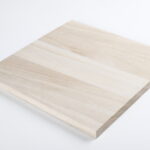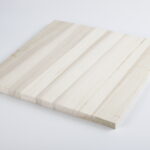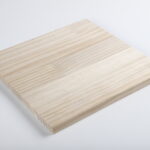
- Type: Natural solid timber board (single-piece, non-engineered).
- Core Material: 100% solid wood from a single log, no fillers.
- Manufacturing: Logs are sawn into planks or slabs, then air-dried or kiln-dried to reduce moisture content; the boards are planned, sanded, and cut to required dimensions, and in some cases, edge-glued to form wider panels while still being considered solid wood.
- Layers + Construction / Adhesive Type: Monolithic construction; no layers or adhesives.
- Thickness Range: Commonly 9 mm – 50 mm.
- Dimensions Available: 1220 × 2440 mm (Standard), or upon request
- Density: Species-dependent (e.g., Softwoods: ~350 – 650 kg/m³; Hardwoods: ~600 – 1,050 kg/m³).
- Moisture Resistance (MR): Naturally moderate; depends on species and finishing. Not waterproof unless treated.
- Fire Rating: Generally, Class C–D (EN 13501-1) without treatment; improved to Class B or better with fire-retardant coatings.
- Formaldehyde Emissions: E0 (no added formaldehyde; natural product).
- Janka Hardness: Varies widely (Softwoods: ~1,000 – 2,500 N; Hardwoods: ~3,000 – 12,000 N).
- Modulus of Elasticity (MOE): Typically, ~8 – 18 GPa depending on species.
- Modulus of Rupture (MOR): Typically, ~50 – 120 MPa depending on species.
- Dimensional Stability: Low to moderate; may expand/contract with humidity changes.
- Surface Finish: Can be rough-sawn, planed smooth, sanded, oiled, lacquered, or painted.
- Color / Appearance: Natural variations; ranges from pale cream to deep brown, often with visible grain patterns unique to each board.
- Durability: Dependent on species; some naturally resistant to decay/insects, solid wood is generally more vulnerable to insects and rot than engineered boards unless treated.
- Mechanical Properties: Good strength-to-weight ratio depending on the species, are easier to work with using hand and machine tools than engineered products, and can be planed, carved, and joined without the risk of delamination.
- Stability: Good when properly dried; susceptible to warping if moisture content changes.
- Water Resistant: Naturally limited; can be improved with sealants or treatments.
- Workability: Excellent for cutting, shaping, and joinery; harder species require sharper tools.
- Screw Holding Strength: High; especially in hardwood species.
- Edge Integrity: Very good; solid edges allow machining and shaping without core exposure.
- Eco Certification: Available with FSC® or PEFC™ certification upon request.
- Estimated Prices: Around ~US $400 – $900+ Per m3 / Final prices depend on raw material quality, board density and thickness, surface treatments, manufacturing technology, customization, regional costs, logistics, market demand, environmental standards, brand reputation, and order volume.
- Use Cases: Lightweight furniture (e.g., cabinets, shelving, tables), Interior paneling and wall cladding, Surfboards and paddleboards (due to low weight and stability), Musical instruments (soundboards, guitar bodies), Wooden crafts and decorative items, Boat interiors (non-structural), Doors and window frames (interior use).