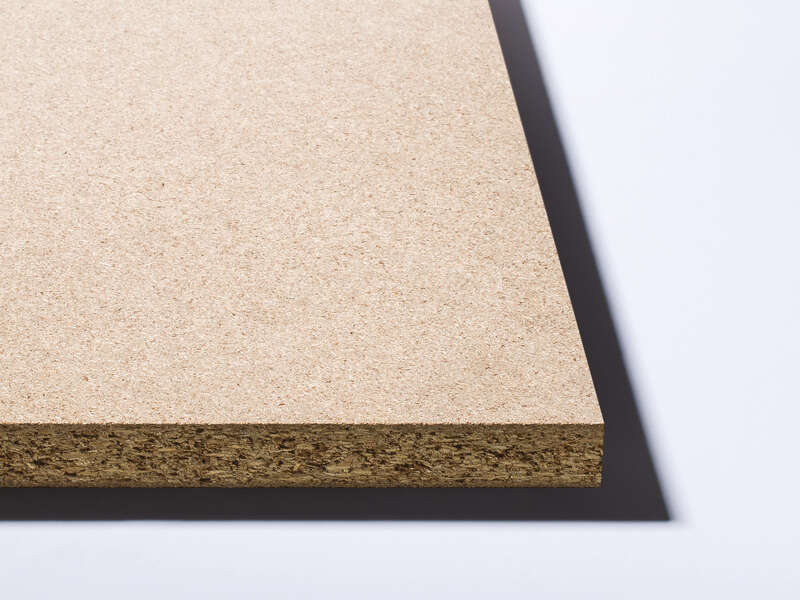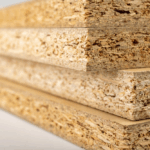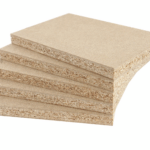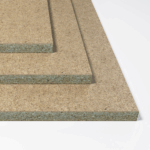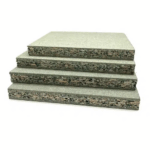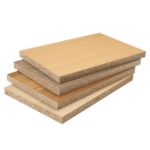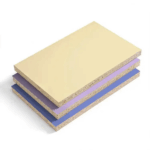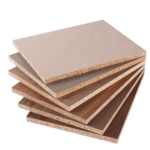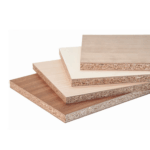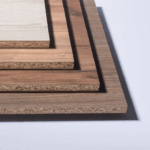
- Type: Made from wood particles bonded with resins and is considered one of the most economical engineered boards.
- Core Material: Compressed wood particles (wood chips, sawdust, shavings) with no specific layering; uniform throughout.
- Manufacturing: Wood particles mixed with adhesives like urea-formaldehyde are compressed under heat and pressure into sheets with a smoother surface and a coarser core.
- Layers + Construction / Adhesive Type: Single-layer or multi-layer (3-layer or graded-density); bonded with Urea Formaldehyde (UF), Melamine Formaldehyde (MF), or Phenol Formaldehyde (PF) resins.
- Thickness Range: Typically come in thicknesses ranging from (6 mm – 40 mm), with the most common sizes being (9, 12, 15, 18, 25 mm). Some manufacturers also produce thinner panels (as low as 3 mm) for backing and thicker panels (up – 50 mm) for specialty furniture or structural uses, but (6 – 30 mm) is the standard commercial range.
- Dimensions Available: 1220 × 2440 mm (Standard), 1220 × 2800 mm, 1220 × 3050 mm, 1525 × 3050 mm, 1830 × 2440 mm, 2100 × 2800 mm.
- Density: ~650 – 750 kg/m³ (varies by type and manufacturer).
- Moisture Resistance (MR): Low (standard); moderate for MR grade; BWR-grade available with melamine or phenolic resins.
- MR Particle Board: Treated with moisture-resistant adhesives and waxes, offering better resistance to swelling and warping compared to standard particle board.
- Fire Rating: Low; fire-retardant versions available.
- Formaldehyde Emissions: E1, E0 (low-emission) and CARB P2 certified boards available.
- Janka Hardness: ~600 – 800 lbf (softer than plywood and MDF).
- Modulus of Elasticity (MOE): ~2,000 – 3,000 MPa.
- Modulus of Rupture (MOR): ~10 – 15 MPa.
- Dimensional Stability: Fair; prone to swelling and warping if exposed to high humidity or water.
- Surface Finish: Smooth; suitable for lamination, paint, melamine, or veneer.
- Color / Appearance: Light tan to pale brown (core); face depends on surface finish (laminate, melamine, etc.).
- Durability: Low durability and is less resistant to impact, moisture, and wear than plywood, MDF, or block board, making it easily damaged by water.
- Mechanical Properties: Particle board has low strength and poor screw-holding capacity, is unsuitable for heavy loads or structural use, and while easy to cut and machine, it is prone to chipping.
- Stability: Good dimensional stability in dry indoor conditions but weakens significantly if it absorbs moisture.
- Water Resistant: Standard particle board is not water-resistant, and while Moisture-Resistant (MR) grades are available, they are still not recommended for prolonged water exposure.
- Workability: Easy to cut and machine; prone to chipping at edges.
- Screw Holding Strength: Moderate (inferior to plywood/MDF); prone to screw loosening.
- Edge Integrity: Poor to fair; edges must be sealed or laminated to prevent crumbling.
- Eco Certification: Available with FSC, PEFC, E1/E0, CARB P2 compliant options.
- Estimated Prices: Around ~US $250 – $600+ Per m3 / Final prices depend on raw material quality, board density and thickness, surface treatments, manufacturing technology, customization, regional costs, logistics, market demand, environmental standards, brand reputation, and order volume.
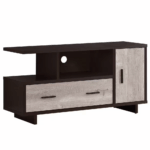
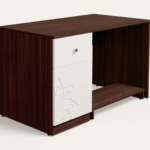
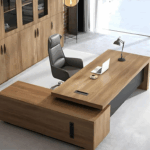
- Use Cases: Low-cost furniture such as flat-pack items, cabinets, shelves, office desks, wardrobe carcasses, and partitions in dry indoor areas, as well as underlayment for countertops with laminate coverings, flooring underlayment, and laminated or veneered interior wall panels.