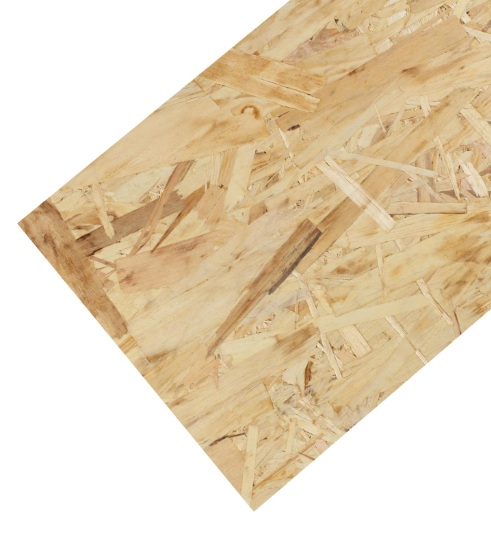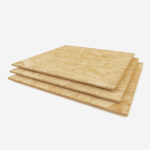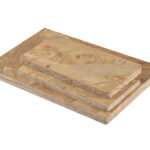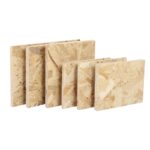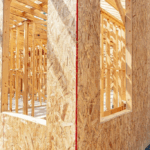
- Type: Made from large, thin wood strands oriented in specific directions and bonded with resins, serving as an alternative to plywood for structural applications.
- Core Material: Wood strands and flakes.
- Manufacturing: Long wood strands are arranged in layers, with outer layers aligned parallel to the panel’s length and inner layers arranged crosswise; these layers are bonded with synthetic resins and wax, then compressed under heat and pressure to form a dense board.
- Layers / Construction: Cross-oriented layers.
- Adhesive Type: Phenol-formaldehyde, MDI.
- Thickness Range: Typically come in thicknesses ranging from (6 mm – 25 mm), with the most common sizes being (9, 11, 15, 18, 22 mm). Some manufacturers offer thicker panels (up to 30 mm) for specialized structural applications, but (6 – 25 mm) is the standard commercial range.
- Dimensions Available: 1220 × 2440 mm (Standard), 1220 × 2745 mm, 1220 × 3050 mm, 1250 × 2500 mm, 1200 × 2400 mm, in some regions (especially for construction sheathing), larger panels Such as: 2400 × 4800 mm (may be available).
- Density: ~600 – 700 kg/m³.
- Moisture Resistance (MR): Moderate to High (OSB/3, OSB/4).
- Fire Rating: Class C (treated types available).
- Formaldehyde Emissions: E1, CARB II.
- Janka Hardness: ~650 – 700 lbf.
- Modulus of Elasticity (MOE): ~3500 – 5000 MPa.
- Modulus of Rupture (MOR): ~30 – 50 MPa.
- Dimensional Stability: Moderate (swells if not sealed).
- Surface Finish: Rough, industrial.
- Color / Appearance: Random flake texture.
- Durability: OSB has good durability for structural use, performing better than particle board but generally offering less moisture resistance than plywood unless specially treated.
- Mechanical Properties: OSB has high strength and stiffness comparable to plywood, with good load-bearing capacity for walls, floors, and roofs, though its edges can be prone to splintering.
- Stability: OSB has good dimensional stability due to its cross-oriented strands, making it less likely to warp than solid wood, but it can swell if moisture penetrates.
- Water Resistant: Standard OSB swells and weakens with prolonged moisture exposure, while OSB/3 and OSB/4 use special resins for enhanced moisture resistance suitable for humid conditions but are not fully waterproof.
- Workability: Fair.
- Screw Holding Strength: Good.
- Edge Integrity: Edge sealing recommended.
- Eco Certification: FSC, CARB.
- Estimated Prices: Around ~US $300 – $500+ per m3 / Final prices depend on raw material quality, board density and thickness, surface treatments, manufacturing technology, customization, regional costs, logistics, market demand, environmental standards, brand reputation, and order volume.
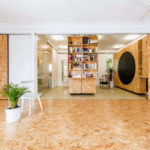
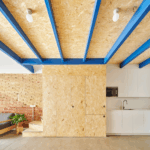
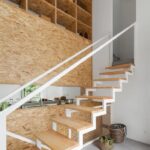
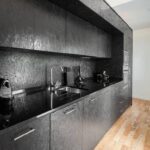
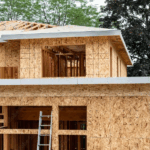
- Use Cases: Used for wall and roof sheathing, subflooring, flooring panels, packaging, crating, furniture carcasses in hidden parts, and temporary structures and formwork.