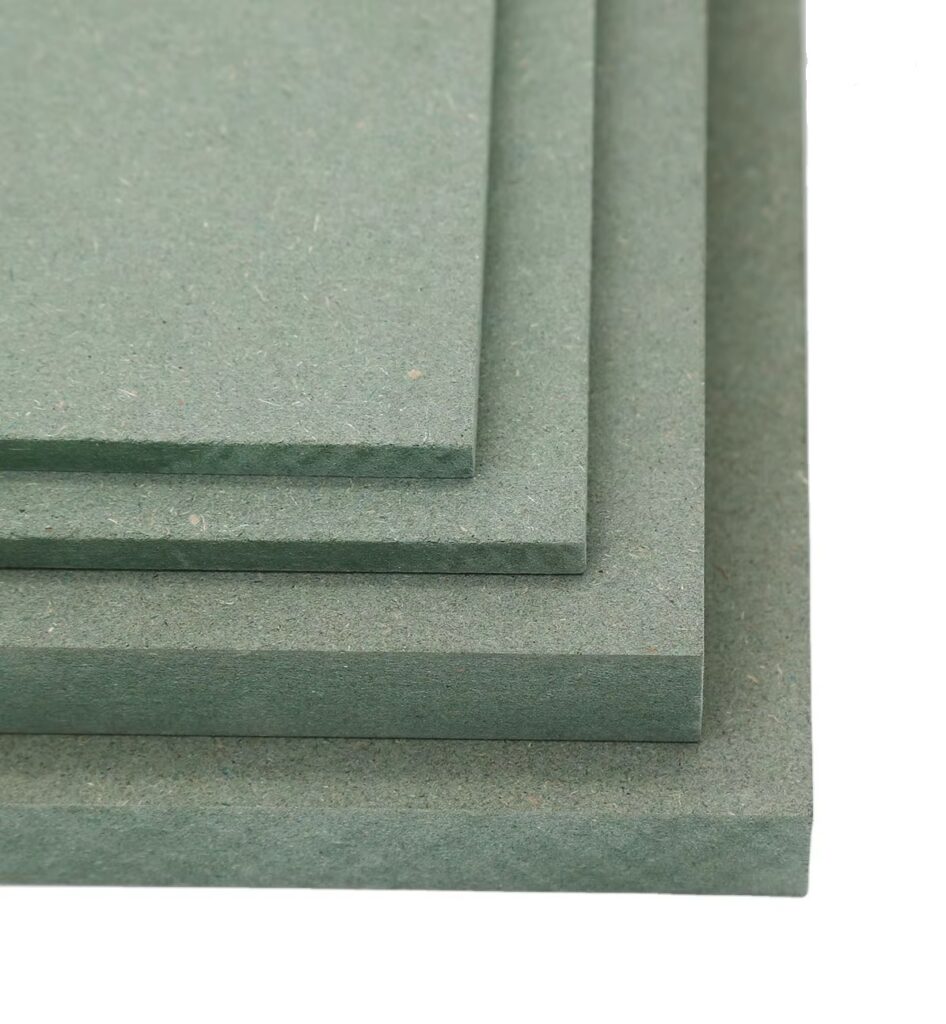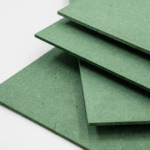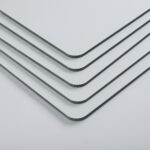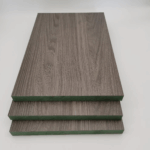
- Type: Made from very fine wood fibers combined with resins and is denser and harder than MDF due to higher compression.
- Core Material: Refined hardwood/softwood fibers + resin binders + optional additives (e.g., moisture-resistant, fire-retardant, anti-fungal agents).
- Manufacturing: Produced by compressing refined wood fibers with resin binders under very high heat and pressure to create a dense, strong, and uniform board.
- Layers / Construction: Homogeneous dense fiber panel.
- Adhesive Type: Urea-formaldehyde or MDI.
- Thickness Range: Typically come in thicknesses ranging from (2.5 mm – 40 mm), with common sizes being (3, 4.5, 6, 8, 12 mm). Some specialty products, such as engineered flooring substrates, may be made slightly thicker (up to about 15 – 18 mm), but (2.5 – 12 mm) is the standard commercial range.
- Dimensions Available: 1220 × 2440 mm (Standard), 1830 × 2440 mm, 1525 × 3050 mm, 2070 × 2800 mm.
- Density: ~850 – 1050 kg/m³ / Very dense, hard, heavy, with high strength and excellent surface finish.
- Moisture Resistance (MR): Low to moderate.
- MR HDF: Moisture-resistant treatments, with a higher density that provides additional durability, making it suitable in humid environments.
- Fire Rating: Class C (can be treated).
- Formaldehyde Emissions: E1, CARB II.
- Janka Hardness: ~1000+ lbf.
- Modulus of Elasticity (MOE): ~4000 – 6000 MPa.
- Modulus of Rupture (MOR): ~45 – 55 MPa.
- Dimensional Stability: Good.
- Surface Finish: Very smooth.
- Color / Appearance: Green, which gradually lightens over time.
- Durability: HDF is highly durable, stronger, and more impact-resistant than MDF, making it less prone to denting or chipping.
- Mechanical Properties: HDF has high strength and hardness, enabling precision machining, better screw-holding than MDF, and suitability for thin, load-bearing panels.
- Stability: Excellent dimensional stability, resists warping, swelling, and shrinking under normal indoor humidity conditions.
- Water Resistant: Not naturally water-resistant, but moisture-resistant panels are available, although they are not fully waterproof.
- Workability: Good.
- Screw Holding Strength: Moderate.
- Edge Integrity: Prone to chipping without edge banding.
- Eco Certification: CARB, FSC.
- Estimated Prices: Around ~US $500 – $1,000+ Per m3 / Final prices depend on raw material quality, board density and thickness, surface treatments, manufacturing technology, customization, regional costs, logistics, market demand, environmental standards, brand reputation, and order volume.
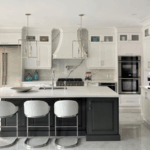
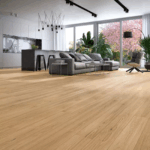
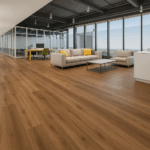
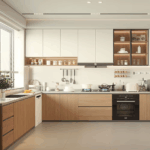
- Use Cases: HDF is used as a core material for laminate flooring, high-quality furniture, and cabinetry. It is also commonly used in kitchens, wall panels, doors, decorative moldings, back panels, and as a substrate for laminates, veneers, and painted finishes. In construction, HDF can also serve as a moisture barrier in wall systems.