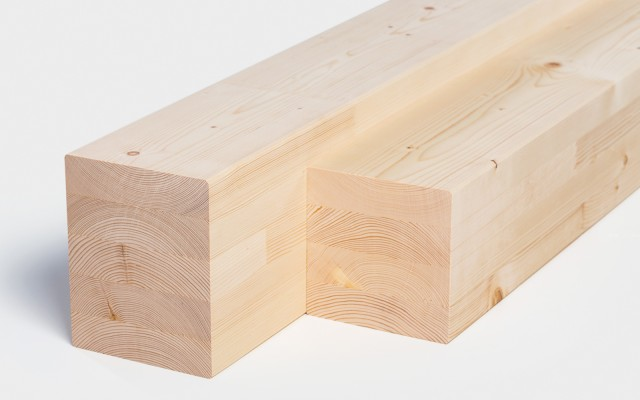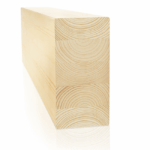
- Type: Made by gluing together multiple layers (lamellas) of solid timber with strong adhesives.
- Core Material: Laminated solid timber (typically softwoods like Spruce, Pine, Douglas Fir); finger-jointed lamellas bonded in layers.
- Manufacturing: Lumber strips, or lamellas, are kiln-dried and planed, then stacked with all grains parallel, unlike CLT’s crosswise arrangement, with adhesives applied between layers; this stack is pressed and cured under heat and pressure to form a strong, solid beam that can be straight, curved, or custom-shaped.
- Layers + Construction / Adhesive Type: Multiple layers glued with waterproof adhesives—Melamine-Urea-Formaldehyde (MUF), Phenol-Resorcinol-Formaldehyde (PRF), or Polyurethane (PUR).
- Thickness Range: Typically come in thicknesses ranging from (35 mm – 250 mm), depending on the number of laminations and the application. Common thicknesses include: (35 mm – 45 mm) per lamination layer. Overall thickness varies as multiple layers are bonded together, often reaching (100 mm – 250 mm) or more for structural beams. Thickness can be customized based on design and structural requirements.
- Dimensions Available: Depth (height of the beam): Typically ranges from (90 mm up to 1800 mm (1.8 m)), depending on the span and structural design. Length: Standard lengths: (6000 mm, 12000 mm), Custom lengths: (Up to 30 m) (depending on transport limits and manufacturer). Panels/Boards (before shaping into beams): Laminated boards themselves are usually (33 – 45 mm) thick, planed, and then glued together. Glulam members can be straight, curved, or custom shaped. Final sizes depend on the structural requirements since glulam is usually made-to-order.
- Density: ~450 – 600 kg/m³ (varies by wood species used).
- Moisture Resistance (MR): High (especially with PRF or PUR adhesives); suitable for humid, exterior, and wet applications.
- Fire Rating: Good inherent fire resistance due to charring behavior; can achieve Euroclass B or better with treatment.
- Formaldehyde Emissions: E1 or E0 compliant; very low emissions when using PUR or MUF adhesives.
- Janka Hardness: Depends on species: Douglas Fir ~660 lbf; Spruce ~510 lbf.
- Modulus of Elasticity (MOE): ~11,000 – 13,000 MPa (typical).
- Modulus of Rupture (MOR): ~30 – 50 MPa depending on grade.
- Dimensional Stability: Excellent; engineered to resist warping, twisting, and shrinkage.
- Surface Finish: Sanded, planed, or rough-sawn; can be stained, oiled, or clear coated for architectural finishes.
- Color / Appearance: Light to reddish-brown tones (depending on species); visible grain; uniform appearance with minimal defects.
- Durability: High durability in dry, protected conditions and can be treated or covered for outdoor use.
- Mechanical Properties: High strength and stiffness, often surpassing solid wood of the same dimensions, with excellent load-bearing capacity ideal for long spans and heavy loads, and can be engineered to meet specific structural requirements.
- Stability: Very dimensionally stable due to controlled manufacturing and removal of natural defects, making them less prone to twisting, warping, or splitting than solid timber.
- Water Resistant: Standard glulam is not waterproof, but beams can be manufactured with exterior-grade adhesives for humid or outdoor conditions, and outdoor glulam must be sealed or finished for protection.
- Workability: Good; can be sawn, drilled, sanded, and machined with standard tools.
- Screw Holding Strength: High; better than solid wood due to consistent grain direction and reduced defects.
- Edge Integrity: Excellent; strong bonding between layers and smooth edges when planed.
- Eco Certification: FSC, PEFC available; also, CE-certified and compliant with EN 14080 (Europe) or ANSI/AITC 117 (North America).
- Estimated Prices: Around ~US $500 – $850+ Per m3 / Final prices depend on raw material quality, board density and thickness, surface treatments, manufacturing technology, customization, regional costs, logistics, market demand, environmental standards, brand reputation, and order volume.
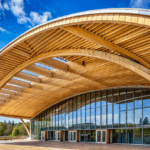
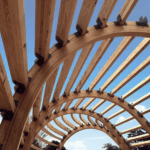
- Use Cases: structural beams, columns, arches, roof trusses, bridges, large-span structures such as stadiums and halls, decorative exposed timber elements, and curved structural members.