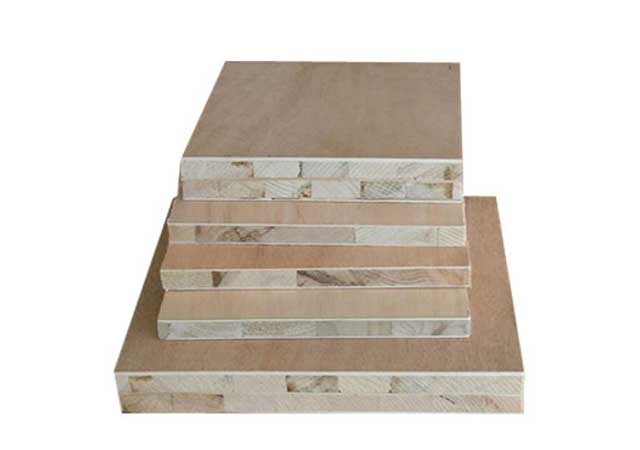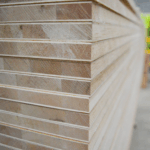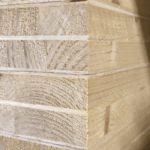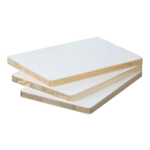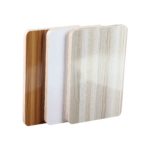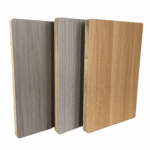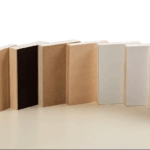
- Type: Made with a core of wooden strips or blocks (usually softwood) sandwiched between layers of veneers (plywood sheets).
- Core Material: Softwood strips (usually Pine) sandwiched between two veneer sheets (typically hardwood or plywood).
- Manufacturing: Narrow wooden strips about 25 – 30 mm wide are glued edge-to-edge to form a core, which is then sandwiched between two hardwood veneer layers and hot-pressed under heat and pressure to create a solid, stable panel.
- Layers / Construction: Cross-banded construction; bonded with Urea Formaldehyde (UF) for interior or Phenol Formaldehyde (PF) for exterior-grade boards.
- Adhesive Type: Many types of adhesives are used.
- Thickness Range: Typically come in thicknesses ranging from 12 mm – 50 mm, with the most common sizes being (16, 18, 22, 25 mm). Specialty orders may be made thinner (around 8 – 10 mm) or thicker (up to 60 mm) depending on the core block size and application requirements.
- Dimensions Available: 1220 × 2440 mm (Standard), 915 × 1830 mm, 1050 × 2100 mm, 1220 × 2135 mm, 1220 × 2745 mm.
- Density: ~500 – 700 kg/m³.
- Moisture Resistance (MR): Moderate (MR grade) to High (BWR/BWP grades available for humid conditions).
- MR Block Board: Core and veneers treated or selected for moisture resistance.
- Fire Rating: Low to moderate (can be fire-retardant treated if required).
- Formaldehyde Emissions: E1 or E0 available depending on adhesive used; E0 for low-emission furniture.
- Janka Hardness: ~600 – 800 lbf (varies by core and face veneer species).
- Modulus of Elasticity (MOE): ~4,500 – 6,000 MPa.
- Modulus of Rupture (MOR): ~30 – 45 MPa.
- Dimensional Stability: Moderate (better than solid wood; less stable than plywood due to potential core voids).
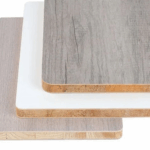
- Surface Finish: Accepts laminates, veneers, paints, and polishes.
- Color / Appearance: Varies by face veneer; typically, light tan to medium brown.
- Durability: Block board has moderate to good durability, is stronger than particle board and MDF, has a softwood core that makes it lighter yet stable, but is not naturally resistant to decay or termites unless treated.
- Mechanical Properties: Good strength and screw-holding capacity, better than MDF and Particle Board. Lighter and stiffer than solid Plywood of the same thickness. Can be easily cut, planed, drilled, and shaped.
- Stability: Block board offers good dimensional stability, though less than MDF or HDF due to its solid wood core, and is less prone to bending than long sheets of plywood.
- Water Resistant: Standard block board is not water-resistant, but BWP and BWR grades with phenolic resins offer improved moisture resistance.
- Workability: Easy to machine, cut, and join; softer core improves workability.
- Screw Holding Strength: Good to excellent (better than MDF, slightly lower than plywood).
- Edge Integrity: Fair to good; edges must be sealed to avoid core separation.
- Eco Certification: FSC, PEFC, or E0-rated adhesives available for sustainable, low-emission options.
- Estimated Prices: Around ~US $350 – $900+ Per m3 / Final prices depend on raw material quality, board density and thickness, surface treatments, manufacturing technology, customization, regional costs, logistics, market demand, environmental standards, brand reputation, and order volume.
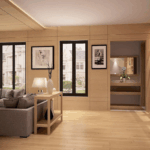
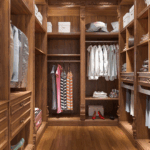
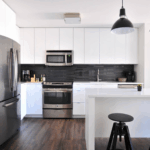
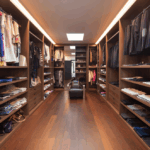
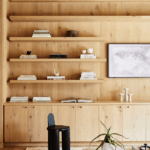
- Use Cases: Block board is used for furniture such as tables, wardrobes, bookcases, and beds, as well as shelving and long panels due to its resistance to bending, and for doors, partitions, wall and ceiling paneling, interior structures, and modular kitchen components.