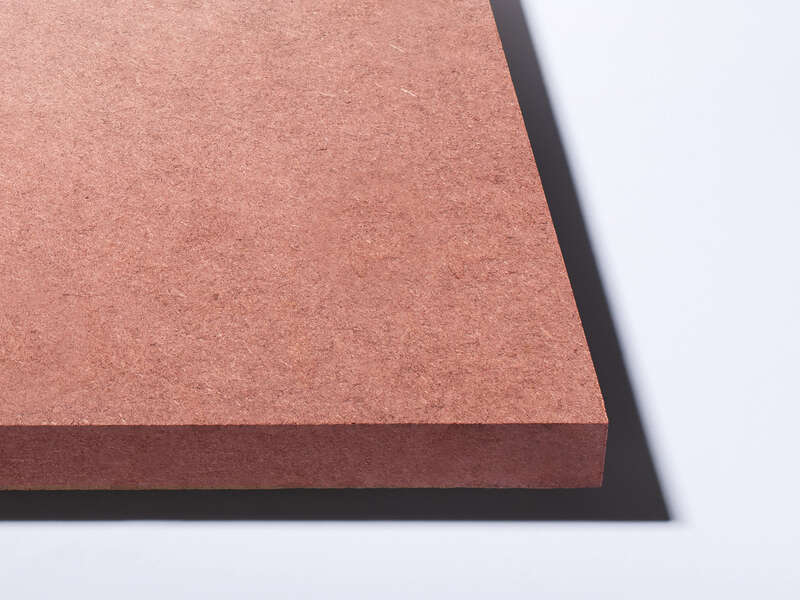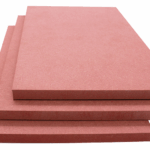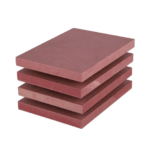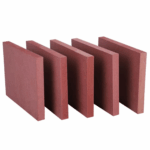
- Type: Engineered wood panel treated to resist or retard fire.
- Core Material: Wood fibers (softwood or hardwood) or wood-based composites, combined with fire-retardant additives and resins.
- Manufacturing: Produced by blending wood fibers with resins and fire-retardant chemicals, then hot-pressing under controlled temperature and pressure to form uniform, stable panels.
- Layers / Construction: Homogeneous or multi-layer composite depending on the board type and fire protection requirements.
- Adhesive Type: Urea-formaldehyde, phenolic, or MDI, compatible with fire-retardant additives.
- Thickness Range: Typically (6 mm – 40 mm); specialty boards may range from 3 mm to 50 mm depending on application.
- Dimensions Available: 1220 × 2440 mm (Standard), 1525 × 3050 mm; custom dimensions may be available.
- Density: ~700 – 1,100 kg/m³ depending on type and additives; higher density for improved fire resistance.
- Moisture Resistance (MR): Low to moderate; moisture-resistant variants may be available.
- MR Fireproof: Fire-retardant boards may include wax or resin treatments to improve moisture resistance while maintaining fire performance.
- Fire Rating: Typically, Class B or C; some boards meet Class A or UL94 standards depending on certification.
- Formaldehyde Emissions: E0, E1, CARB II, NAUF variants available for eco-friendly and low-emission requirements.
- Janka Hardness: ~500 – 1,000 lbf, depending on density and core material.
- Modulus of Elasticity (MOE): ~2,000 – 5,000 MPa, depending on type and density.
- Modulus of Rupture (MOR): ~15 – 50 MPa, depending on board density and core.
- Dimensional Stability: High under dry indoor conditions; may swell if exposed to moisture unless moisture-resistant variant is used.
- Surface Finish: Smooth, ready for laminates, veneers, or paint; fire-retardant surface treatment may alter texture slightly.
- Color / Appearance: Reddish-brown due to fire-retardant additives; uniform texture.
- Durability: More durable than standard Boards but less durable than solid hardwood; fire-retardant additives improve longevity in fire-exposure scenarios.
- Mechanical Properties: Good bending and compression strength for interior and light structural applications; impact resistance moderate.
- Stability: Resistant to warping, swelling, or shrinkage under controlled indoor humidity conditions.
- Water Resistant: Not fully waterproof; some fireproof boards include moisture-resistant treatments.
- Workability: Easy to cut, route, machine, and finish; specialized blades may be required for high-density fireproof boards.
- Screw Holding Strength: Moderate; pre-drilling recommended for thin boards.
- Edge Integrity: Edges may chip if not sealed or banded.
- Eco Certification: Available with FSC®, PEFC™, CARB, and NAUF versions may be available.
- Estimated Prices: Around ~US $500 – $1,200+ Per m3 / Final prices depend on raw material quality, board density and thickness, surface treatments, manufacturing technology, customization, regional costs, logistics, market demand, environmental standards, brand reputation, and order volume.
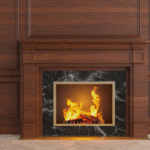
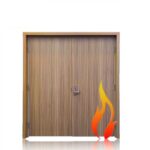
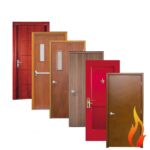
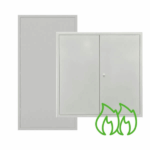
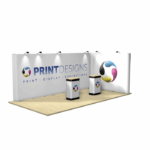
- Use Cases: Interior wall panels, partitions, false ceilings, decorative panels, doors, cabinetry, furniture components, exhibition stands, and areas requiring fire-retardant performance in compliance with building codes.