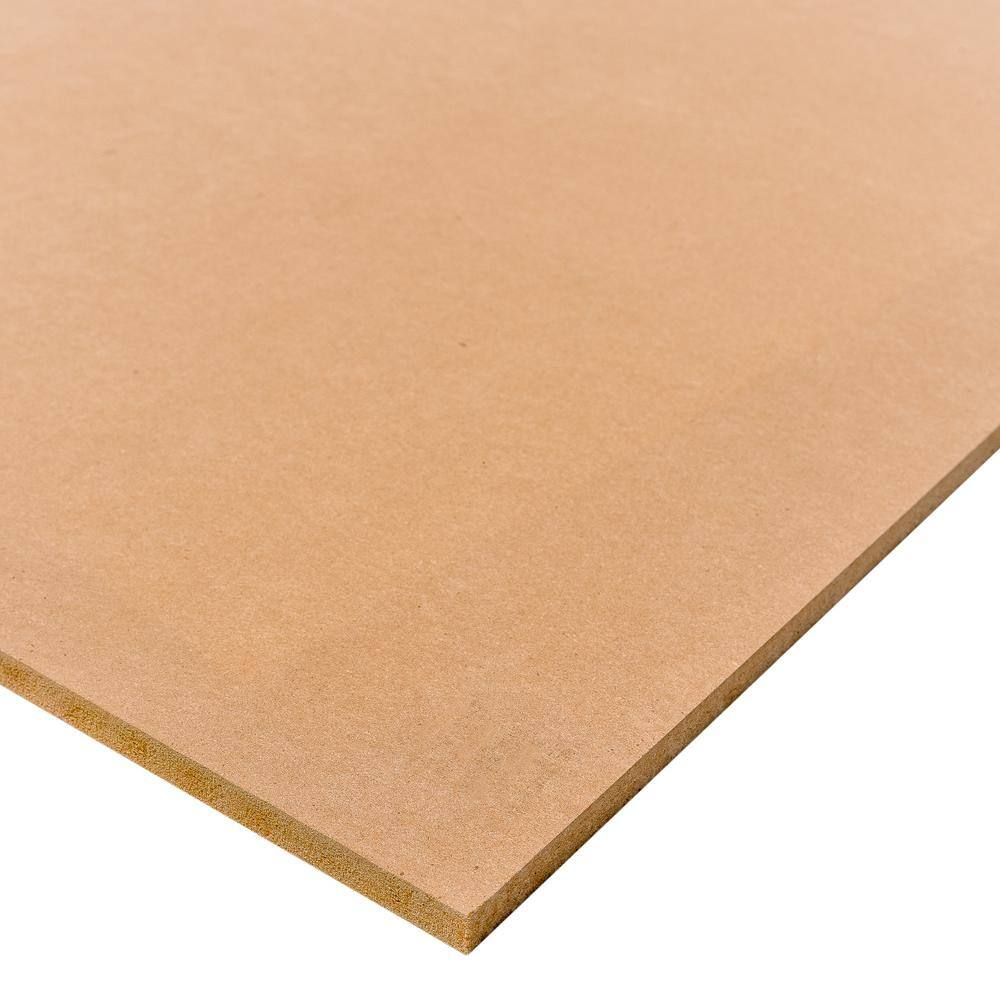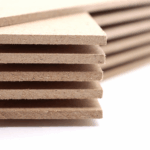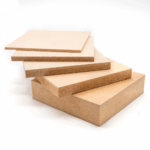
- Type: Made from wood fibers bonded with resins and additives.
- Core Material: Wood fibers mainly come from softwoods and may include recycled or agricultural fibers.
- Manufacturing: Wood fibers mixed with resin and wax are pressed at lower pressure, lighter, and temperature than MDF boards.
- Layers / Construction: A single-layer board, though some specialty versions have a denser surface with a lighter core.
- Adhesive Type: Urea-formaldehyde resins are commonly used, with low-emission boards using E0/E1 grades or melamine-urea-formaldehyde.
- Thickness Range: Typically ranges from (3 mm – 40 mm) for specialty uses, with the standard commercial range being (6 mm – 30 mm); the most common thicknesses are (9, 12, 15, 18, 25 mm).
- Dimensions Available: 1220 × 2440 mm (Standard), 1525 × 3050 mm, Custom sizes may also be available.
- Density: ~400 – 650 kg/m³ (lighter than MDF) / Lightweight and less strong, often used where weight savings matter.
- Moisture Resistance (MR): Standard LDF has low moisture resistance and swells when wet; moisture-resistant LDF is treated for limited water resistance.
- MR LDF: Wax or resin treatments improve moisture resistance in LDF, but it remains limited and is used where lightness and some moisture resistances are needed.
- Fire Rating: Standard LDF isn’t fire-resistant, fire-retardant versions exist.
- Formaldehyde Emissions: Common LDF grades meet E1 or CARB Phase 2 low-emission standards, with E0 and NAUF versions for eco-friendly use.
- Janka Hardness: ~200 – 300 lbf (0.9 – 1.3 kN), Not suitable where impact or dent resistance is critical.
- Modulus of Elasticity (MOE): ~1,500 – 2,000 MPa.
- Modulus of Rupture (MOR): ~12 – 18 MPa.
- Dimensional Stability: LDF is stable indoors in dry conditions but poorly stable with humidity changes or moisture.
- Surface Finish: LDF has a smooth surface that easily accepts laminates, paints, and veneers for decorative finishes.
- Color / Appearance: Typically, light tan to pale brown, with a uniform, fine-fiber texture and no visible grain pattern.
- Durability: LDF is pale beige to light brown, lighter in color and more porous than MDF.
- Mechanical Properties: Low bending, impact, and screw-holding strength due to low density.
- Stability: Dimensionally stable in controlled interior conditions.
- Water Resistant: Standard LDF is not water-resistant, while MR LDF offers limited resistance.
- Workability: Easy to cut, rout, and machine due to its low density, causing less tool wear than MDF.
- Screw Holding Strength: LDF has low screw-holding strength, so screws can strip easily and pre-drilling is recommended.
- Edge Integrity: LDF has soft edges prone to crushing, so they must be sealed or edged to prevent damage.
- Eco Certification: Often available with FSC® or PEFC™ certification.
- Estimated Prices: Around ~US $300 – $600+ Per m³ / Final prices depend on raw material quality, board density and thickness, surface treatments, manufacturing technology, customization, regional costs, logistics, market demand, environmental standards, brand reputation, and order volume.
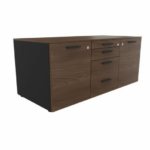
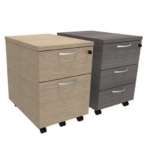
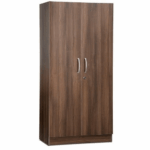
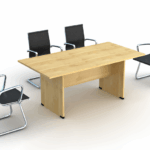
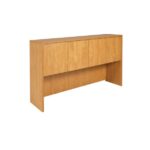
- Use Cases: Lightweight furniture components such as doors and shelves where high strength isn’t required, as well as wall panels, partitions, false ceilings, display panels, exhibition stands, decorative panels with laminates or veneers, packaging, and crafts, but it is not recommended for exterior or wet areas.